
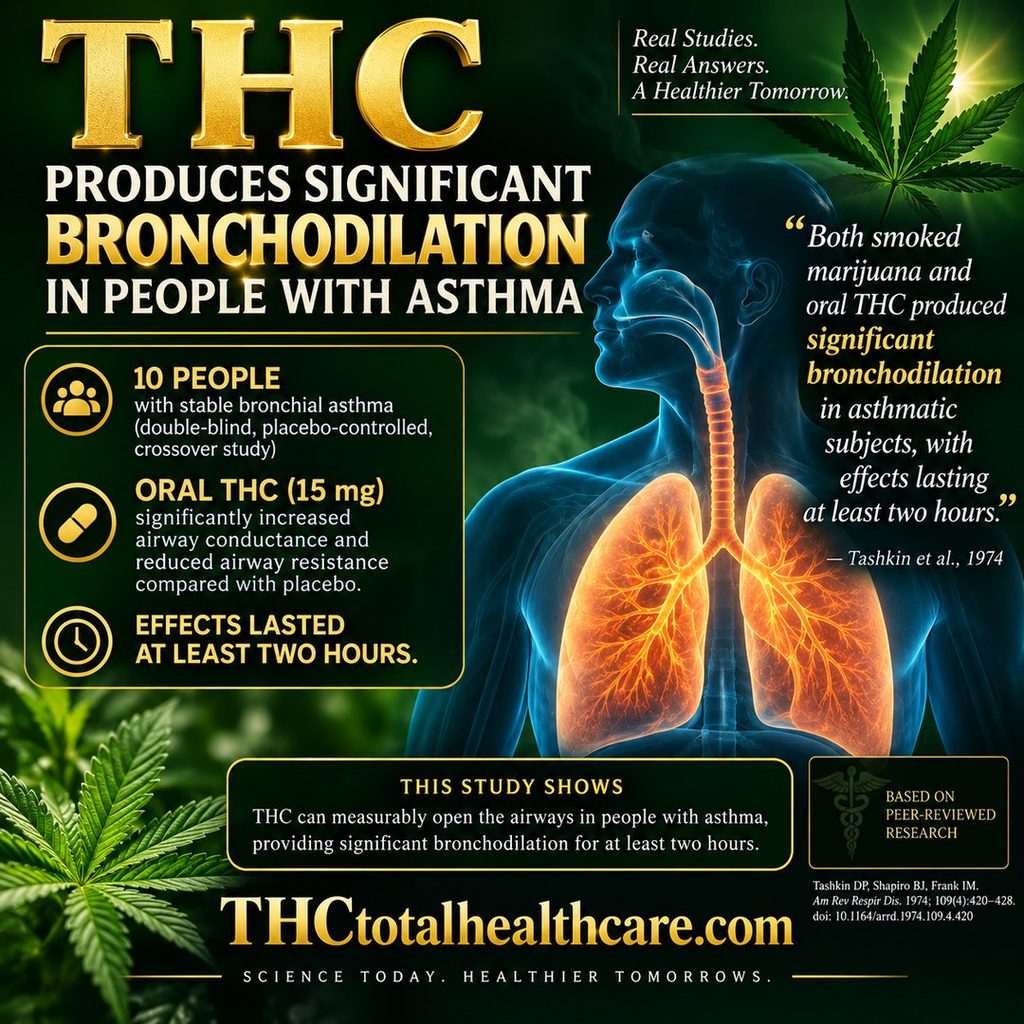
A human study found that Δ9-tetrahydrocannabinol (THC) produced significant bronchodilation in people with stable bronchial asthma. In the double-blind crossover trial, researchers compared smoked marijuana and oral THC with placebo and measured changes in airway function. Oral THC significantly increased specific airway conductance and reduced airway resistance, showing that THC was able to measurably open the airways. The bronchodilator effect lasted for at least two hours, providing early clinical evidence that THC can directly affect respiratory function in people with asthma.
“The acute effects of smoked 2 per cent natural marijuana (7 mg per kg) and 15 mg of oral Δ9-tetrahydrocannabinol (THC) on plethysmographically determined airway resistance (Raw) and specific airway conductance (SGaw) were compared with those of placebo in 10 subjects with stable bronchial asthma using a double-blind crossover technique.
After smoked marijuana, SGaw increased immediately and remained significantly elevated (33 to 48 per cent above initial control values) for at least 2 hours, whereas SGaw did not change after placebo. The peak bronchodilator effect of 1,250 µg of isoproterenol was more pronounced than that of marijuana, but the effect of marijuana lasted longer.
After ingestion of 15 mg of THC, SGaw was elevated significantly at 1 and 2 hours, and Raw was reduced significantly at 1 to 4 hours, whereas no changes were noted after placebo.
These findings indicated that in the asthmatic subjects, both smoked marijuana and oral THC caused significant bronchodilation of at least 2 hours’ duration.”
https://pubmed.ncbi.nlm.nih.gov/4816823
Need this THC study explained? thcXplained.com